
Copywriting: Interview & Profile of a faculty member
It was tough getting time with this new faculty member, but we managed to grab around 45 minutes in his office, where I could hastily scribble down some notes on his fascinating teaching and publication career. Often, I’m just blown away by the caliber of people I get to work with, and it’s a real privilege to hear their remarkable stories and life experiences, and this subject was no exception.
CLIENT: Fowler School of Law
Faculty Interview and Profile
PROJECT:
Copywriting example generated from a one-hour interview for a web and print profile.
Think Like A Lawyer: Welcoming Dr. Riaz Tejani to FSOL
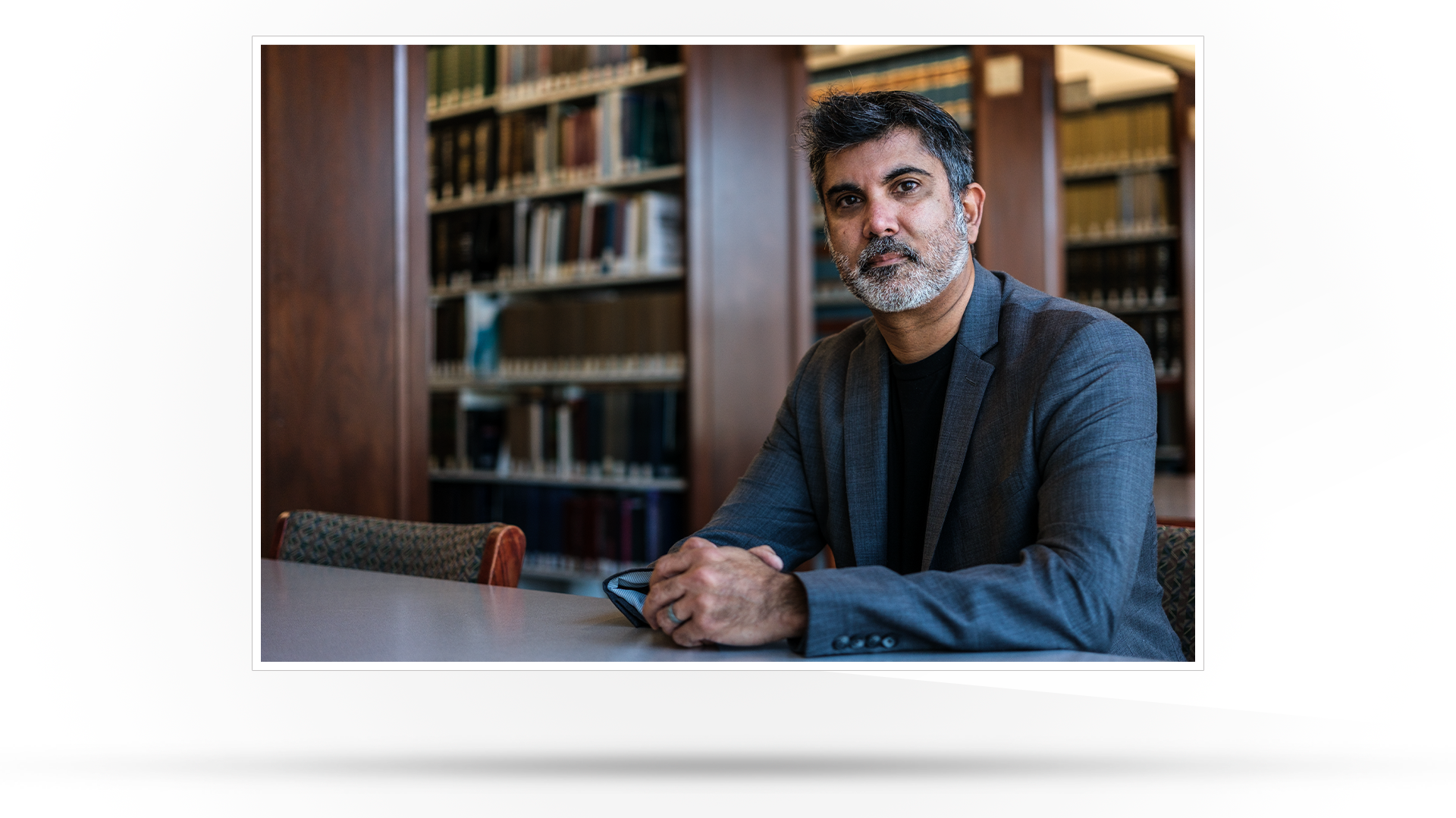
Fowler School of Law scholars recently welcomed a new team member to the school, Dr. Riaz Tejani, whose legal scholarship sheds light on the social and cultural impacts of law and economics in legal theory, legal education and professional legal ethics. A prolific researcher and author, Tejani’s authorial credits already include titles like: Law Mart: Justice, Access, and For-Profit Law Schools, an ethnographic investigation of for-profit legal education during and following the 2008 global financial crisis; Law and Society Today, a critical survey of contemporary themes in socio-legal studies; and, his most recent book, Law and Economics: New Trajectories in Law, a critical introduction to the field of law and economics for socio-legal and humanities scholars.
Tejani currently serves on a number corporate and non-profit boards and has been a public arbitrator for the Financial Industries Regulatory Authority (FINRA). He is co-director of the Law and Society Association’s CRN 28 on New Legal Realism, an associate editor for Political and Legal Anthropology Review, and board member and program chair for the Law and Humanities Interdisciplinary Workshop—a consortium of faculty from Penn, Stanford, Georgetown, UCLA and USC. His work is routinely cited in publications such as the Harvard Law Review, Yale Law Journal Forum, Annual Review of Law and Social Science, The Nation, and NPR, with select writings reprinted or translated in India, Sri Lanka, Bangladesh, Pakistan, and China.
Originally mentored by leading legal Anthropologist Dr. Elizabeth Mertz, Tejani’s scholarship in law and economics first emerged from his formative social science and anthropology studies, which accompanied him into the law school classroom. As he puts it, “Sitting there, I became increasingly aware of the socio-cultural structures informing the legal constructs I was studying, I started to think about how and why we speak about legal issues the way that we do and the underlying thinking that informs what counts as ‘a legal problem’ and what doesn’t.”
For Tejani, law and economics are fascinating and routinely recurring bedfellows in the legal classroom, pervading almost every aspect of the law school curriculum. As he sees it, our concepts of justice are formed and continue to be shaped by the economics and outcomes of the choices and decisions made within the legal system and its frameworks of understanding and action.
Imparting the critical lens this perspective lends in the classroom is part of Tejani’s subtle yet impactful approach to teaching law. Teaching the core, foundational issues first, he gradually introduces a self-reflexive and critical alternative to students to illustrate the limits of a particular approach, drawing a critical question out of them: “What does the law look like when you view justice in the light of these new, critical possibilities?”
“Our concepts of what is just or unjust seem to be in constant evolution,” says Tejani, suggesting that the law is a living, gestalt-like construction–in perpetual evolution as culture, human understanding and social mores evolve. For his students, Tejani hopes to imbue his classes with self-reflexivity, empowering students to question their own place in the law and examine where they exist and interact within its structures.
With the legal profession currently adapting to the widespread use of Artificial Intelligence, Tejani’s critical, reflexive approach to the law may have something to teach us, both about the economics of the AI adoption as well as the ethical dilemmas that routinely crop up for practitioners already using this fledgling technology.
“We might do well to view AI in a limited, circumspect capacity,” he offers, “I think AI could be used effectively as an assistant, but little more. In law, when you use an assistant, you are obliged to observe certain ethical duties regarding their capacity to assist you. For example, there may be certain training and limits on case information access that limit what your assistant can or should do for you. No right-minded lawyer should ever consider their assistant to be some sort of case-winning Übermensch brimming with all the answers,” he quips.
Tejani trains his students with an eye to instilling in them better critical judgment. One of his favorite classroom exercises is to present students with fact patterns and memos created by both AIs and third-year associates, which students must audit and evaluate for errors in thinking, legal research and potential AI hallucinations. For Tejani, readying his students for the rigors and pitfalls of modern professional practice is not simply a matter of teaching them torts and contracts, but also teaching the essential critical skills to work responsibly with new technologies, using them wisely to improve their professional performance as lawyers by leveraging their own critical self-reflexivity.
For now, progress is incremental, but Tejani sees a future in legal education where these critical safeguards are built into the classroom conversation, where topics like ethics and law and society help to inform critical distance for emergent professionals and become an essential part of the ubiquitous classroom emphasis of training students to “think like a lawyer.”
